Evidence of hearing improvement and tinnitus reduction through laser therapy

Visible improvement in audiometry

The audiogram (or audiometry) is the most important diagnostic method for assessing the biological condition of the inner ear.

Just as an X-ray reveals the biological quality of a joint, the audiogram reveals the individual biological quality of the inner ear.

In a completely healthy ear, the audiogram shows a level of -10 decibels across all frequencies.

The worse the audiogram value, the greater the strain on the inner ear and the louder the test tone must be to be audible.

That’s also the problem with hearing aids. They all amplify the sound in an inner ear that is already overwhelmed by loud noise.

For further evaluation of an audiogram, the so-called hearing loss line is important. This line is at 30 dB across all frequencies.

This means that those affected often only hear the test tone when their audiogram falls below this 30 dB line.

Thankfully, this condition is not irrevocably set in stone, because the inner ear has a high capacity for regeneration.

Home therapy with our mobile Dr. Wilden Ear Laser utilizes this natural power of cellular self-regeneration to gradually improve the existing biological quality.

80% of all tinnitus patients hear a high-frequency tinnitus tone. At the same time, there is a high-frequency hearing loss visible in the hearing curve, and this can be explained by a simple fact.

The hair cells responsible for our ability to hear high and very high frequencies are subjected to the greatest mechanical stress.

All hair cells sit on an elastic membrane, the so-called basilar membrane, which has a vibration pattern similar to a guitar string.

Guitar strings break at the top of the twist, not in the middle.

Similarly, the hair cells responsible for high frequencies are located at the very top of the basilar membrane.

Below we show you some hearing curves that demonstrate the improvements in hearing and other impairments, such as tinnitus, dizziness, hyperacusis, etc., through our laser therapy (photobiomodulation):

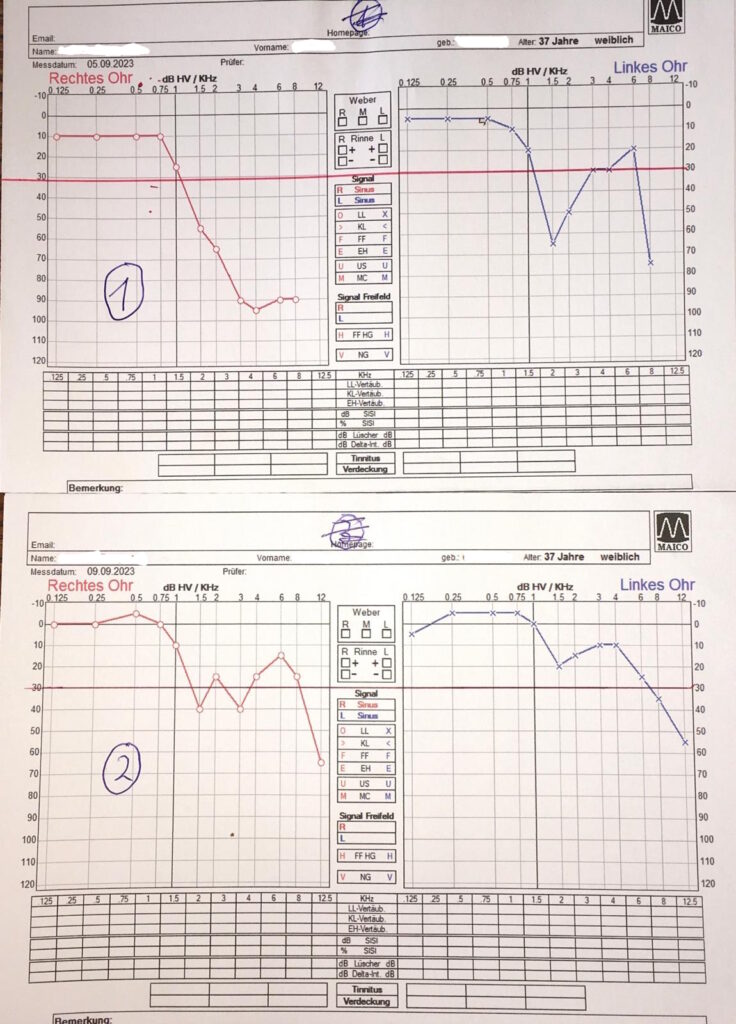
Audiogram 1

This audiogram shows the situation of a 37-year-old woman who suffered from the following symptoms:

Upper audiogram (1): Severe inner ear strain for more than 3 years in the high-frequency range bilaterally, more pronounced in the right ear than the left, with distressing tinnitus bilaterally for more than 5 years.

Lower audiogram (2): After only 3 days of laser therapy, the hearing curve already shows significant improvements in the high and mid-frequency ranges. The patient can now hear considerably better and the overall symptoms show improvement.

Audiogram 2

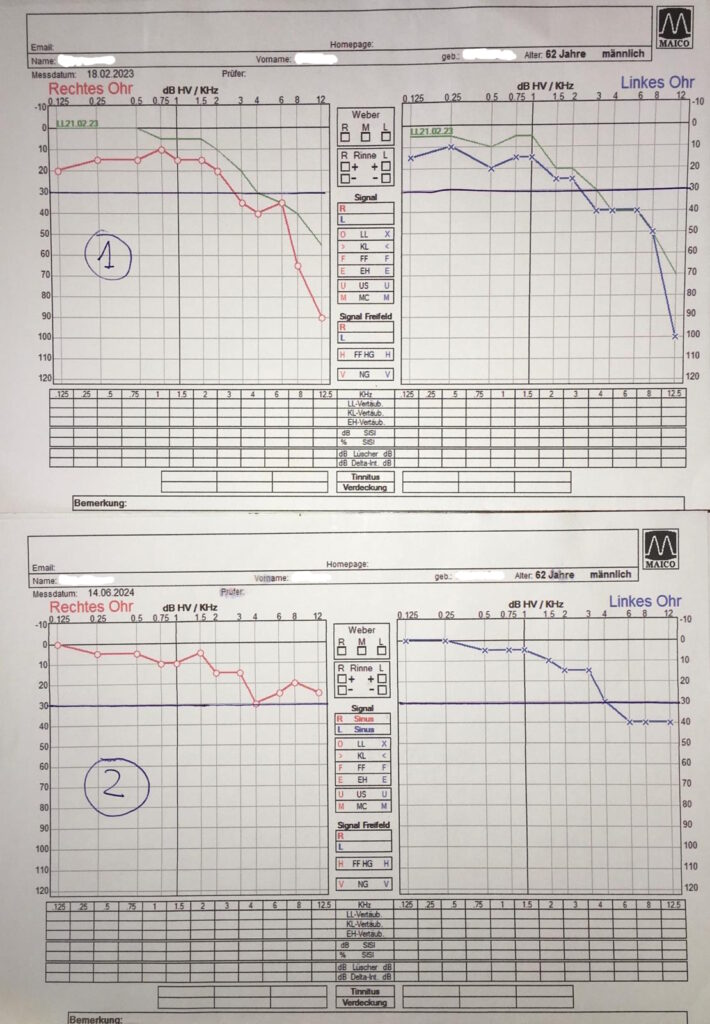
This audiogram shows the situation of a 62-year-old man who suffered from the following symptoms:

Upper audiogram (1): Hearing loss, hyperacusis, dysacusis, ear pressure, tinnitus, vertigo. The symptoms were present in both ears.

Lower audiogram (2): After more than a year of treatment with photobiomodulation, there has been a significant increase in the high-frequency range. In some cases, the increase is now at a level comparable to that of significantly younger individuals.
Hyperacusis, dysacusis, and vertigo were no longer present. Tinnitus was extremely reduced.

Audiogram 3

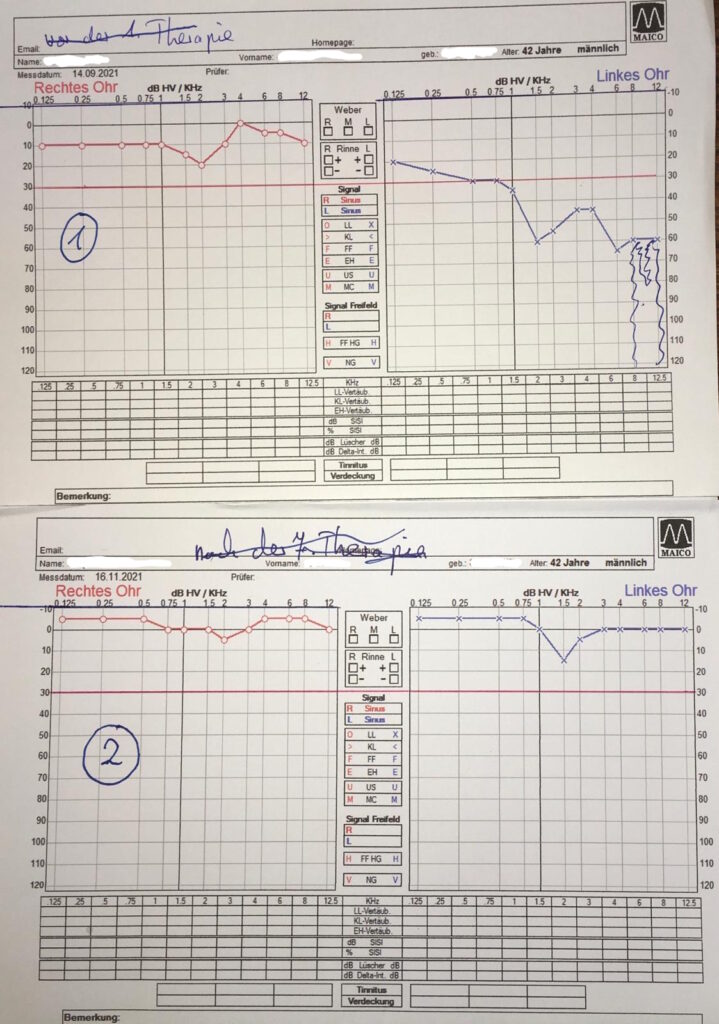
This audiogram shows the situation of a 42-year-old man who suffered from the following symptoms:

Upper audiogram (1): Condition following sudden hearing loss on the left side one year ago, Meniere’s disease, tinnitus more pronounced on the left than on the right, hearing loss more pronounced on the left than on the right.

Lower audiogram (2): Excellent improvement in hearing and all other symptoms after 2 months of high-dose photobiomodulation.

Audiogram 4

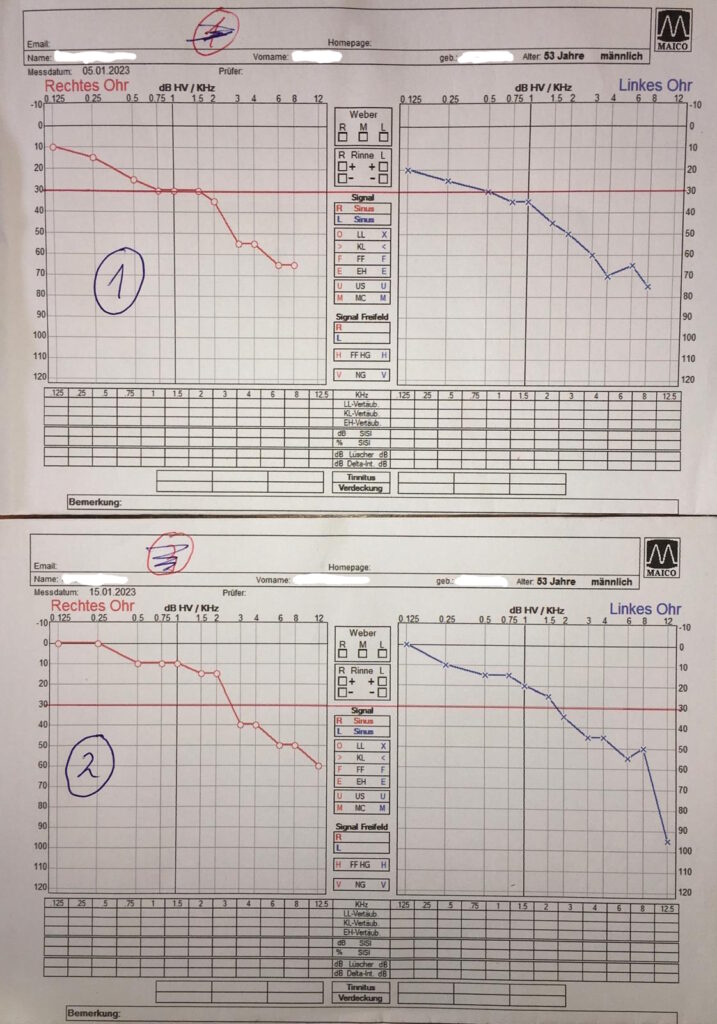
This audiogram shows the situation of a 53-year-old man who suffered from the following symptoms:

Upper audiogram (1): Severe tinnitus in both ears, high-frequency hearing loss, hyperacusis in both ears. Pressure in both ears. Vertigo, significant hearing loss in both ears across all frequencies for the past 4 years.

Lower audiogram (2): Hearing improved by 15-25 dB across almost all frequencies. The 12.5 kHz frequency, the highest measured and previously inaudible, is now perceptible again.

A significant improvement in all other symptoms is also present.

Audiogram 5

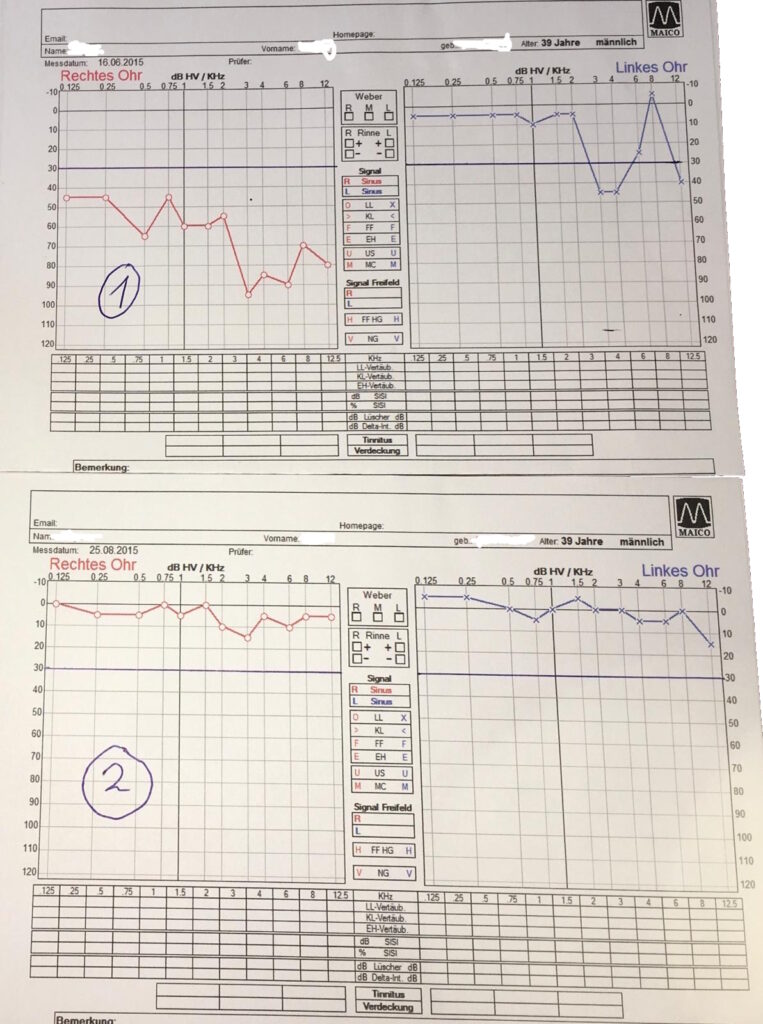
This audiogram shows the situation of a 39-year-old man who suffered from the following symptoms:

Upper audiogram (1): Severe hearing loss on the right, hyperacusis and dysacusis bilaterally. Pressure in the right ear, vertigo, incipient Meniere’s disease.

Lower audiogram (2): After two months, the patient’s hearing was completely normal and even better than expected for his age group. All symptoms had completely resolved.

en_USEN